
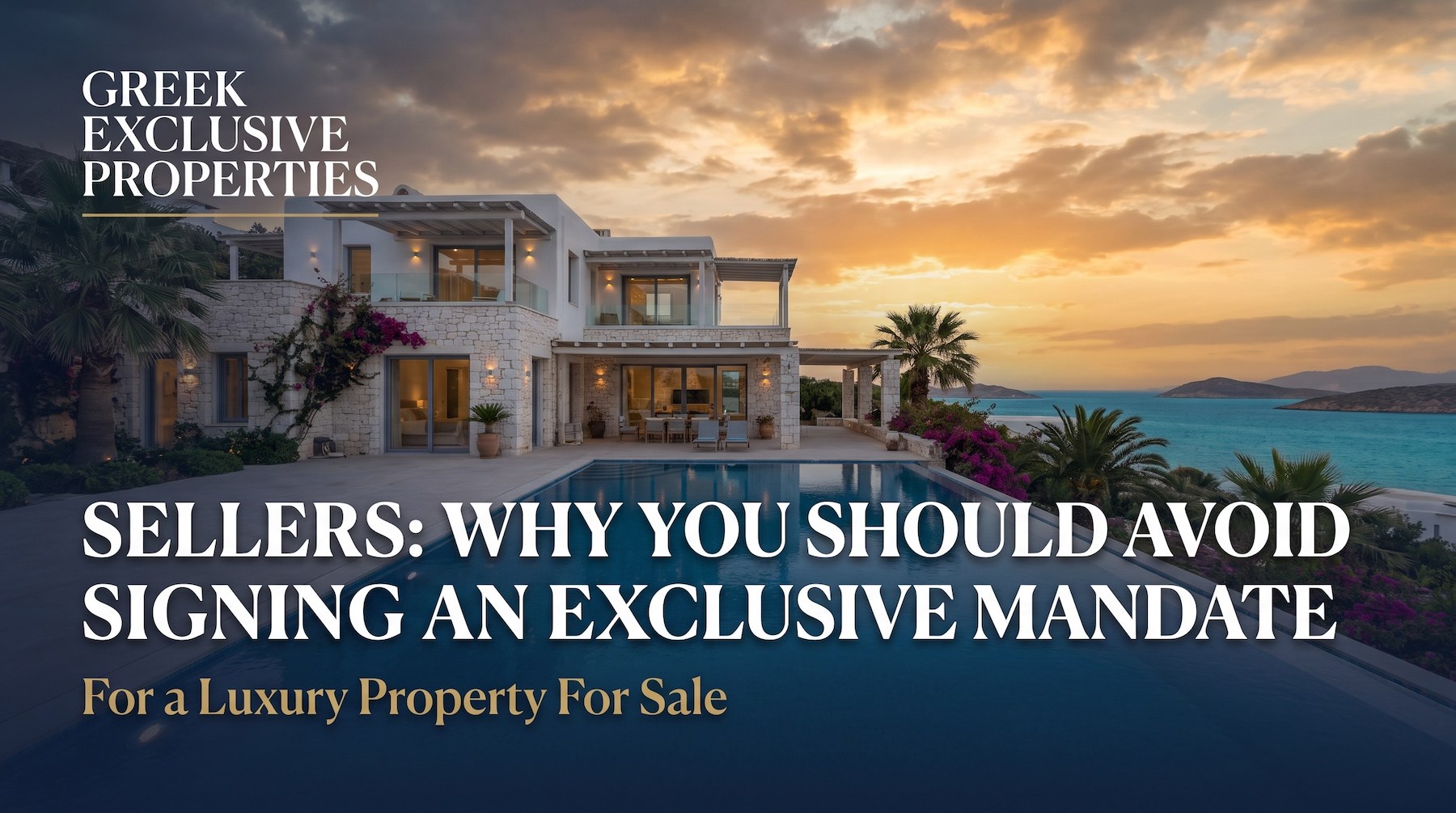
Market Insight • Selling & Buying Luxury
A signature on an exclusivity contract is not a sale. For villas and estates priced between €3 and €20 million, it is often the reason a sale never happens.
A familiar pattern repeats itself across the Greek islands and the southern suburbs of Athens, year after year. An owner with an exceptional property, a villa in Halkidiki, an estate on Corfu, a caldera mansion in Santorini, sits down with a well known real estate office and signs a contract granting six, sometimes eight months of exclusivity. The presentation is polished. The promises are confident. Figures are shown: buyer databases in the thousands, average days on market, projected sale timelines. And the property disappears from the open market for the better part of a year, represented by one office and one office only.
We think owners of property in the €3 to €20 million range deserve a harder look at that arrangement before they sign it, because in this specific segment of the market, exclusivity rarely delivers what it promises. What it reliably delivers is months of one office holding a valuable asset off the wider market, while the buyers who could have closed it look elsewhere.
The Promise Behind Every Exclusivity Pitch
No agency asks for exclusivity by admitting uncertainty. The pitch is always the same shape: a confident sales projection, a polished set of statistics about buyer reach and past performance, and an assurance that committing to one office, and one office only, is what a property of this calibre requires. Owners are told, in effect, that exclusivity is what serious sellers do.
What is rarely said out loud is how often that promise goes unfulfilled. A very large share of luxury villas and mansions listed under long exclusivity agreements in Greece do not sell within the term of the contract. The agency's own statistics, the buyer numbers, the market reach figures, the comparable sales, are presented at the signing table and are almost never revisited afterward with the same confidence. When the exclusivity period ends without a sale, the explanation offered is rarely that the projection was wrong. It is usually a request to renew, on the same terms, for another six to eight months.
This is the core problem with exclusivity in this price range. It asks an owner to take an agency's word for its own future performance, then removes the one mechanism, competition from other offices, that would otherwise hold that promise accountable.

The Conflict Owners Rarely See Coming
Beyond the unfulfilled promise, there is a second, quieter cost. A qualified international buyer, working through their own broker or advisor, identifies a property they want to see. That buyer's representative reaches out to the listing office, only to find the terms of cooperation unattractive, the communication slow, or the commercial split simply not workable for their side. Rather than fight through it, the buyer's team quietly moves on to the next property on their list.
In other cases, the buyer is willing to wait. They like the estate enough to sit on their hands until the exclusivity period lapses, at which point they intend to approach the seller directly or through an agency they already trust. This is not a theoretical scenario. It is something we see directly at Greek Exclusive Properties: buyers reach out to us about a specific villa still under someone else's exclusivity, and rather than deal with that office, they simply wait, telling us plainly that they would rather work with us once the property is free to be shown properly. Either way, the owner never learns that a real buyer existed during those months. All they see, at the end of the exclusivity period, is a listing that generated interest but no sale, statistics that were never tested, and an agency asking to renew the very agreement that quietly cost them the deal.
What long exclusivity periods routinely produce
- Confident projections, unverified afterward. The buyer numbers and timelines presented at signing are rarely checked against what actually happened once the contract runs its course.
- Buyers who wait it out. We regularly hear this directly: a buyer contacts Greek Exclusive Properties about a property still under another office's exclusivity, and chooses to wait for that agreement to expire rather than deal with the current listing office at all.
- Buyers who simply move on. A buyer with several €3 to €20 million properties on their shortlist rarely waits. If access through the current listing office is difficult, the property is dropped, not chased.
- Renewal pressure without new results. At the end of a long exclusivity term with no sale, the next step offered is almost always another exclusivity term, on the same statistics, not a change in approach.
Why Exclusivity Rarely Suits This Price Range
At €3 to €20 million, a property is not competing for attention among thousands of active local buyers the way a city apartment is. The realistic pool of buyers able and willing to transact at that level in Greece, at any given time, is genuinely small, and it is international, meaning that buyer may already be in conversation with several different brokers, advisors, or family offices before a single Greek agency ever hears their name.
In a pool that small, restricting a property to a single office is not a marketing strategy. It is a bet that one specific agency happens to already know, or will happen to find, the handful of people on earth who are both able and willing to buy that exact estate. The odds of that bet paying off within six to eight months are considerably lower than owners are led to believe at the signing table.
The alternative is simple, and it is the standard in most mature luxury markets internationally: let more than one qualified office represent the property at once, on a non-exclusive basis, and let the buyer, wherever they come from and whichever agency brought them, determine who closes the sale. May the best office sell the property. That is not a weaker approach for a seller. It is the only approach that puts the outcome ahead of any single agency's convenience.
The Buyer's Side of the Same Problem
Owners are not the only ones affected by how a luxury listing is handled. Buyers of premium Greek property, particularly international buyers researching from London, Zurich, Dubai or New York, increasingly raise the same complaint about a specific segment of the market: the large, internationally branded real estate offices that have expanded into Greece over the past several years.
These offices are not without their strengths, brand recognition chief among them. But buyers who have worked with them consistently describe the same pattern. Communication runs through call centres or rotating junior staff rather than one dedicated advisor who actually knows the property and the island. Response times slow once the initial inquiry is past the qualification stage. And the commercial terms, in more than a few documented cases, run higher than what a boutique brokerage charges for the same class of asset, a cost that is quietly absorbed into the deal structure and, one way or another, into the buyer's final price.
For a buyer spending several million euros on a villa they may have seen twice before flying in to close, the difference between a personal, knowledgeable advisor and an anonymous corporate process is not a minor detail. It is often the deciding factor in which property they pursue and which one they quietly let go.
What Serious Sellers and Buyers Should Look For Instead
If You Are Selling
- No exclusivity, or none beyond what you can end freely, so any qualified office can bring you a buyer at any time.
- Verifiable results instead of projected statistics, offered without needing a signature first.
- Full transparency on every inquiry, including buyers who looked and did not proceed, and why.
- Direct access to the person actually handling your sale, not a call centre.
If You Are Buying
- One advisor who knows the property, the seller's position and the island itself in detail.
- Straightforward, negotiable commercial terms explained upfront, not buried in the process.
- Fast, direct communication that does not route through multiple layers of staff.
- A brokerage genuinely motivated to close the specific property you want, not to move you toward whichever listing is easiest for them.

Why Boutique, Done Properly, Outperforms Big
Scale is a genuine advantage in some businesses. In luxury real estate, it is frequently the opposite. A boutique structure, where listings are handled personally rather than rotated through call-centre staff, will consistently outperform a large corporate portfolio, because every high value sale in Greece still depends on the same handful of things a large office structurally struggles to deliver: a trusted relationship with the owner, an advisor who has walked the property and knows its story, and a negotiation handled by someone empowered to actually make decisions, rather than a set of projected statistics handed over at the signing table. None of this requires a narrow portfolio. It requires the right structure behind a wide one.
This is the case for working with a boutique brokerage rather than a large branded chain, and for keeping representation open rather than locked to one office, not as a matter of opinion, but as a matter of how these specific transactions actually get done. Sellers keep control of their own asset and their own timeline. Buyers get a direct line to someone who can answer a real question instead of escalating it. And neither side pays for a marketing apparatus, or a set of unverified numbers, that exists to justify an exclusivity contract rather than to close a sale.
Where a Villa Gets Advertised Matters as Much as Who Sells It
There is a further cost to working with the large international offices that owners rarely factor in at the signing table: where the property actually gets advertised. To maximise volume across every price point they handle, many of these offices syndicate their full inventory, including seven and eight figure estates, out to a wide network of generic local property portals alongside ordinary apartments and holiday homes. It is a volume strategy, and it is not built with a €5 million villa in mind.
For a property in this range, that kind of exposure does real damage. A caldera mansion or a private island estate listed next to standard local listings signals, correctly or not, that the property is being treated as ordinary inventory rather than a rare asset. Serious buyers notice. It cheapens the perceived positioning of the property, and in a market driven almost entirely by perception and scarcity, that is not a cosmetic issue, it affects the price a buyer is willing to pay.
We do not do this. Every property we represent is promoted exclusively through channels built for this segment of the market, international platforms with a genuinely global, high net worth audience, including Bloomberg, The New York Times, and JamesEdition. A villa in this price range should be seen by the people who can actually buy it, in the context that reflects its value, not spread across every local portal an office happens to syndicate to.

Greek Exclusive Properties was built specifically around this gap in the market. We are a boutique agency by structure, not by reach: our portfolio covers luxury villas, estates and mansions across every major Greek destination, Santorini, Mykonos, Paros, Naxos, Lefkada, Zakynthos, Corfu, Crete, Halkidiki and the Athens Riviera among them, giving owners and buyers the same depth of choice as any international name, without the exclusivity requirement and without the overhead that comes with a global franchise. We do not ask owners to lock a property away from the rest of the market on the strength of a projection. We would rather compete for a sale on results than secure a listing on a promise, and we tell owners exactly what interest their property is generating, including the buyers who looked and stepped back, and why. For buyers, that same structure translates directly into cost: our commercial terms are consistently lower than those of the large international offices operating in Greece, for the same calibre of property and the same level of service.
For buyers, that same structure means one advisor from first inquiry to closed transaction, someone who has seen the property in person, understands the seller's position, and can move quickly when the moment to negotiate arrives. It also means commercial terms that reflect a boutique operation, not the overhead of an international franchise.
Represent Your Property Properly
If you own a luxury villa or estate in Greece and want honest visibility into who is actually interested, without locking yourself into an exclusivity agreement, we would welcome the conversation.
If you are searching for a premium property in Greece and want a direct, personal, and straightforward buying experience, our portfolio is a good place to start..