The Strategic Stack: Why High-Volume Production Requires Model Routing
In the early days of generative media, the “magic prompt” was the industry’s holy grail. The idea was simple: input a paragraph of descriptive text, hit generate, and receive a finished commercial asset. For hobbyists, this remains a delightful novelty. For professional operators, creative directors, and marketing teams, this “one-and-done” approach has proven to be a practical dead end.
The shift we are seeing today is the move from prompt engineering to model routing. Professional creators no longer expect a single model to handle every stage of a production. Instead, they are building modular pipelines where different models—varying in speed, fidelity, and specialized logic—are assigned specific roles. In this environment, the ability to decide which engine handles the foundation and which handles the final “polish” is becoming the most critical skill in the creative tech stack.
The Death of the ‘Magic Prompt’ Monoculture
The industry is maturing past the stage of aesthetic surprise. We are now in the era of strict brand requirements, specific layout needs, and high-volume output. A single prompt, no matter how well-crafted, rarely survives the scrutiny of a commercial brief. This is because high-fidelity models, particularly those focused on video, often prioritize “vibe” and fluid motion over rigid structural accuracy or text legibility.
In a professional agency environment, the workflow is being bifurcated into “exploration” and “production.” Exploration requires extreme speed and low latency to validate concepts. Production requires high-fidelity rendering and temporal consistency. Trying to use a production-grade AI Video Generator for the exploration phase is not just expensive; it is a massive drain on time.
Operators are now acting as air traffic controllers. They route the initial composition, the structural layout, and the text rendering to one set of tools, and then hand off those refined “anchor frames” to a secondary engine for motion and final lighting. This layered approach ensures that the heavy lifting of video generation only begins once the underlying logic of the visual is solidified.
The Iteration Barrier: Why Speed Dictates the Start
The most significant bottleneck in AI-assisted creative work is the “iteration loop.” If it takes three minutes to see a low-resolution video output, a creator can only test 20 variations in an hour. If a model provides nearly instant feedback, that number jumps to hundreds.
This is why tools like Nano Banana AI have become foundational to the routing process. When an operator is brainstorming a color palette or testing the spatial arrangement of objects within a frame, they don’t need a heavy video engine. They need a fast, responsive interface that allows for rapid restyling and refinement.
Using a specialized image engine for the initial phases reduces the cognitive cost of waiting. In creative work, momentum is fragile. Long render times during the conceptual stage lead to “decision fatigue,” where creators settle for “good enough” rather than pushing for “right.” By using Nano Banana AI to validate the composition first, the operator ensures that when they finally commit to a multi-minute video render, the core DNA of the shot is already approved.
Text Rendering and Compositional Control
One of the persistent “known unknowns” in generative media is how well a model will handle embedded typography or specific brand elements. Most high-end video generators are notorious for “hallucinating” text, turning a simple logo or headline into a garbled mess of pseudo-Latin characters.
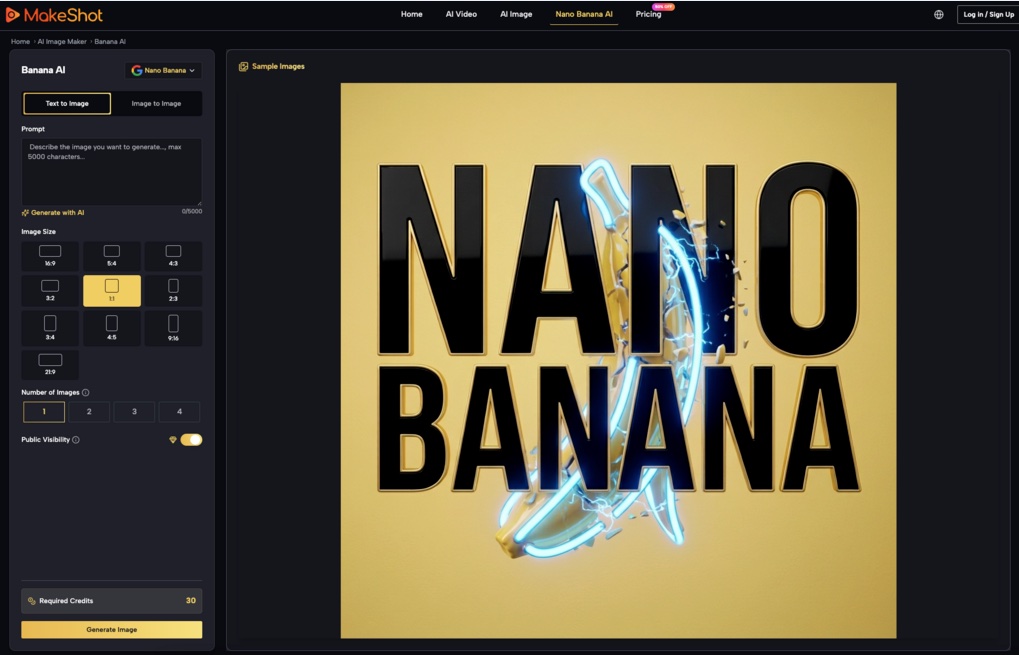
This is a primary reason for routing text-heavy or high-precision layouts to a dedicated image tool first. Banana AI is frequently used as the “anchor frame” generator precisely because it allows for better control over these static elements. If a social media ad requires a clear, legible headline over a cinematic background, the logical workflow is to perfect that frame in a static environment first.
The “Anchor Frame” methodology is now a standard practice. Instead of asking an AI Video Generator to “create a video of a futuristic car with the word ‘SPEED’ on the side,” an operator creates the car and the text in a static image. This image serves as the ground truth. When this frame is fed into a video model, the engine has a fixed reference point. It no longer has to invent the text; it only has to animate the surroundings. This dramatically increases the success rate of the final output.
Transitioning to Motion: The AI Video Generator Hand-off
Once the composition is locked and the text is legible, the workflow moves to the kinetic stage. This is the hand-off point where the operator evaluates the “kinetic potential” of a static image. Not every great image makes a great video.
The operator looks for specific visual cues that translate well into motion:
- Depth Maps: Does the image have clear foreground, midground, and background elements that a video engine can interpret?
- Lighting Cues: Are the light sources defined enough to allow for realistic reflections or shadows during a camera pan?
- Temporal Consistency: Is the subject’s form distinct enough that it won’t morph into something else when the pixels start moving?
The AI Video Generator is then tasked with interpreting these cues. The goal here isn’t to change the image, but to extend it into the fourth dimension. Modern operators use specific settings—often referred to as “motion buckets” or “guidance scales”—to control how much the video engine is allowed to deviate from the original Nano Banana AI reference frame.
It is important to note an area of current limitation: the “translation loss” between models. Even with a perfect anchor frame, a video engine may subtly change the texture of a fabric or the hue of a sunset. We cannot yet guarantee 100% fidelity between the static source and the moving result, which is why the iteration loop often cycles back to the start if the motion introduces unwanted artifacts.
Where the Workflow Fractures: Risks and Limitations
Despite the efficiency of model routing, the process is far from flawless. There are several areas where operators must exercise caution and manage expectations.
The Consistency Gap
Maintaining character likeness or specific environmental details across different generation engines remains a significant challenge. If you generate a character in one model and try to animate it in another, there is a “uncanny valley” of consistency. The eyes might change shape, or the wardrobe might slightly shift style. Professional workflows often require manual post-production or “Inpainting” to fix these discrepancies, as model-to-model communication is still in its infancy.
Unpredictable Artifacts
When moving from high-fidelity static images to fluid motion, “boiling” or “ghosting” artifacts are common. A hyper-detailed texture that looks beautiful in a static Banana AI render might become a shimmering mess when the AI Video Generator tries to move the camera. Operators must often “dumb down” the detail in the source image to help the video engine maintain temporal stability.
Narrative Context
Perhaps the most important limitation to acknowledge is that we are nowhere near a “one-click” automated pipeline that understands narrative. AI can generate a beautiful shot, but it doesn’t know why that shot matters to the story. The routing process is still entirely human-led; the operator must decide which model “feels” right for the mood of the piece.
The Economic Logic of Tool Specialization
Finally, we must address the commercial reality of these tools. In a professional setting, credits and compute time are resources that must be managed. Brute-forcing a high-cost video model for every single creative whim is a poor business strategy.
A tiered system provides a much better ROI:
- Tier 1 (Exploration): Use fast, efficient tools like Nano Banana AI for high-volume brainstorming and layout validation.
- Tier 2 (Refinement): Use specialized image tools to fix text, adjust color grading, and finalize the “Hero Frame.”
- Tier 3 (Production): Use the heavy-duty AI Video Generator only when the creative direction is 90% locked in.
This modularity also future-proofs the production stack. If a new, better video model is released tomorrow, the operator doesn’t have to rethink their entire process. They simply swap out the Tier 3 component while keeping their exploration and refinement stages intact.
The most valuable asset in the modern creative economy isn’t knowing how to write a prompt; it’s knowing how to build a pipeline. By understanding the strengths and weaknesses of each model in the stack—from the speed of a foundational engine to the cinematic power of a video generator—operators can produce high-quality work at a scale that was previously impossible. The “magic” isn’t in the prompt; it’s in the routing.