


The AI Music Test That Started With Distrust
Choosing an AI Music Generator is harder than it looks because many tools make a strong first impression before the real problems appear. A homepage may promise quick songs, polished vocals, clean instrumentals, or royalty-free music, but the test becomes different once you actually try to make something usable. Pop-ups interrupt the flow. Interfaces hide the next step. Some tools feel exciting for five minutes and tiring after twenty. That was the reason I tested ToMusic AI against several other AI music platforms with a practical question in mind: which one would I still want to open again after the first round of curiosity faded?
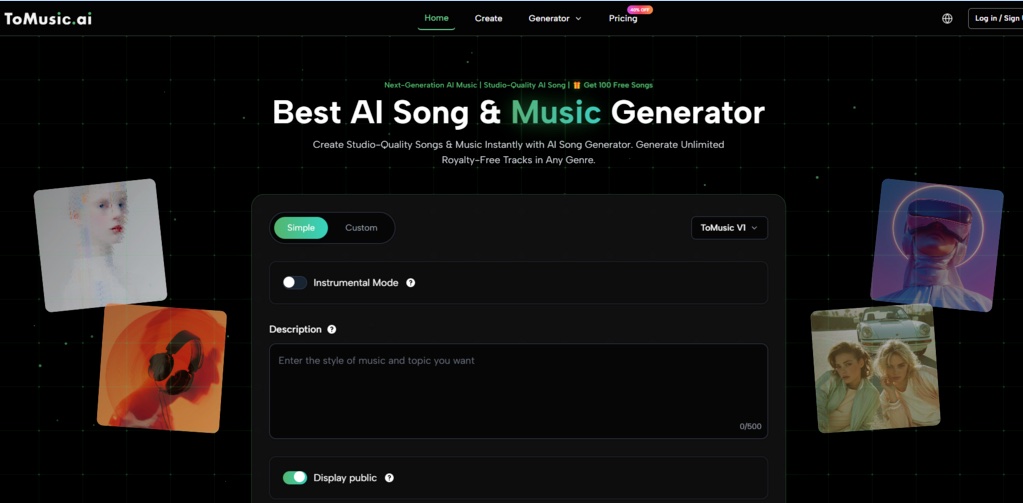 I did not approach this comparison as a search for the loudest demo. AI music tools can all produce surprising moments. A chorus may suddenly work. A piano line may sound more emotional than expected. A synthetic vocal may land close enough to be useful for a draft. But daily creative work depends on smaller things: whether the page feels clean, whether the prompt box is understandable, whether loading feels reasonable, whether ads break concentration, and whether the generated result is easy to manage afterward.
That is where ToMusic AI stood out in my testing. It did not feel like the most aggressive platform, and that actually helped. The experience felt more focused on moving from idea to output without making the user fight the page. I would not describe it as flawless, because AI music generation still depends heavily on the prompt, lyrics, style direction, and the user’s patience. But compared with tools that felt crowded or overly promotional, ToMusic AI gave me a stronger sense of control and repeatability.
Why Low Friction Matters More Than Hype
The first thing I noticed during testing was that AI music platforms often compete on promise before they compete on experience. Many tools tell users they can create full songs in minutes. That promise is not meaningless, but it is incomplete. The harder question is whether the user can create, listen, adjust, and try again without losing focus.
A music generator has a different rhythm from an image generator. You do not judge the result instantly. You wait, listen, notice the vocal tone, evaluate the melody, check whether the style matches the prompt, and then decide whether to revise. If the interface is messy, if advertising interrupts the page, or if generated tracks are hard to organize, the whole process becomes heavier than it needs to be.
ToMusic AI felt stronger because its basic path was easy to understand. The official workflow supports starting with a simple prompt or moving into a more custom direction with lyrics, style, mood, tempo, instruments, and vocal choices. That matters because many users do not begin with a finished song idea. They begin with an emotional sketch: a cinematic intro, a soft acoustic chorus, a dreamy pop mood, or a background track for a short video.
My Practical Testing Method
I tested each platform with ordinary creative pressure rather than extreme prompts. I wanted to know how each tool handled simple, repeatable tasks: a short social video track, a lyric-based pop draft, a calm background instrumental, and a more emotional vocal idea. I also paid attention to whether the page encouraged revision or made me want to leave after one attempt.
The Five Criteria I Actually Used
The comparison focused on five experience-based criteria: sound quality, loading speed, ad distraction, update activity, and interface cleanliness. These are not the only things that matter, but they reveal whether a tool is useful beyond the first experiment.
| Platform | Sound Quality | Loading Speed | Ad Distraction | Update Activity | Interface Cleanliness | Overall Score |
| ToMusic AI | 9.0 | 8.7 | 9.2 | 8.8 | 9.1 | 8.96 |
| Suno | 9.1 | 8.3 | 8.2 | 9.0 | 8.0 | 8.52 |
| Udio | 9.2 | 8.0 | 8.1 | 8.9 | 7.9 | 8.42 |
| Soundraw | 8.4 | 8.8 | 8.5 | 8.1 | 8.6 | 8.48 |
| Mubert | 8.1 | 8.9 | 8.3 | 8.0 | 8.2 | 8.30 |
| Beatoven | 8.0 | 8.5 | 8.4 | 8.0 | 8.4 | 8.26 |
The scores are based on my practical testing impression rather than laboratory measurement. Suno and Udio remain strong in musical surprise and vocal ambition. Soundraw and Mubert can feel efficient for background music use cases. Beatoven is still relevant for structured content music. But ToMusic AI gave me the most balanced overall experience because the page felt less distracting while still supporting prompt-based and lyric-based creation.
Where ToMusic AI Felt Easier To Trust
Trust in an AI tool does not come only from the output. It comes from whether the user understands what is happening. In my testing, ToMusic AI made the creative path feel more visible. I could begin with a simple idea, then become more specific when needed. That matters because many people using AI music tools are not producers. They may be video editors, marketers, indie creators, teachers, small business owners, or writers trying to hear a lyric idea.
The official site presents ToMusic AI as a platform for generating music from text and lyrics, with support for different styles, moods, tempos, instruments, and vocal or instrumental directions. That gives the user enough control without forcing a technical production workflow. It also supports generated works being saved in a music library, which becomes more important after several attempts.
 The Difference Between Testing And Browsing
Browsing a tool is easy. Testing a tool is different. During browsing, a crowded interface can still look impressive. During testing, every small interruption becomes more noticeable. If an ad appears at the wrong moment, it breaks the listening mindset. If a result disappears into a confusing history page, the user loses momentum. If the page is too busy, the prompt feels harder to write.
The Clean Interface Advantage
ToMusic AI’s advantage, in my experience, was not that every output was automatically better than every competitor. It was that the product felt easier to return to. The interface did not make the process feel heavier than the song idea itself. That sounds simple, but in creative software, simple is often the difference between trying once and trying ten times.
How The Official Workflow Actually Works
A useful AI music tool should make the first attempt feel understandable. ToMusic AI’s process can be described without inventing hidden steps, which is a strong sign for users who want a clear path rather than a confusing feature maze.
Four Steps From Idea To Music
The basic process begins with choosing a simple or custom generation path. A simple path works better when the user has a general idea and wants the AI to interpret it. A custom path is more useful when the user already has lyrics, a desired style, or a clearer vocal direction.
Next, the user enters a prompt or lyrics. This can include genre, mood, tempo, instruments, vocal direction, or whether the track should lean instrumental. For lyric-based songs, the user can prepare lyrics before generation, which usually improves the result.
Then, when needed, the user can work with the available AI music model options. The official site describes multiple AI music models, so it is safer to understand this as a model-based creation system rather than a single fixed generator.
Finally, the user generates the result, reviews it, and uses the Music Library to save, manage, search, or download generated work.
Where Prompt Quality Still Matters
This is also where the limitation appears. ToMusic AI can make the process easier, but it cannot magically understand a vague creative idea with perfect accuracy every time. In my testing, clearer prompts usually produced more useful results. A prompt like “slow emotional piano ballad with soft female vocal and cinematic atmosphere” gives the system more direction than “make a sad song.” For custom lyrics, structure matters too. Verses and choruses benefit from being organized before generation.
What The Other Platforms Still Do Well
A fair comparison should not pretend that other platforms have no strengths. Suno and Udio can be impressive when the goal is a striking vocal result or a more surprising song draft. They often feel powerful for users who want to explore musical ideas quickly and are comfortable with some unpredictability.
Soundraw and Mubert can be practical when the goal is background music rather than lyric-driven songwriting. They may appeal to users who need music beds for videos, presentations, or commercial-style content. Beatoven can also make sense for creators who think in terms of mood-based background scoring.
The reason ToMusic AI ranked first in my overall test was balance. It looked less like a tool trying to win one spectacular demo and more like a platform designed for repeatable creation. That is especially important for users who want to move between prompt-based music and lyric-based song creation without switching tools.
 Why Text-Based Creation Feels Practical Here
The value of Text to Music is not just convenience. It changes the starting point of music creation. Instead of opening a complex production environment, the user can begin with language: a mood, a scene, a story, a pacing direction, or a lyric idea. That makes music generation more accessible to people who understand the feeling they want but do not necessarily know how to produce it manually.
ToMusic AI felt useful here because the official workflow supports both simple and custom creation. This gives beginners a place to start while giving more prepared users a way to shape the result. In my testing, that middle ground mattered more than I expected.
Useful Scenarios I Could Actually Imagine
The tool seems especially suitable for creators who need fast music drafts for short videos, YouTube intros, personal projects, educational content, small campaigns, and early-stage song ideas. The official site presents generated music as suitable for commercial creative use, which is relevant for creators who need practical output rather than private experiments only.
Where I Would Still Be Careful
I would still avoid treating any AI music platform as a guaranteed final-production solution on the first attempt. Some results may need regeneration. Some lyric structures may need rewriting. Some prompts may create a style close to the target but not quite there. That is not a failure unique to ToMusic AI; it is part of the current AI music workflow.
A Balanced Tool For Repeatable Song Drafting
After comparing multiple platforms, my main takeaway is that the most useful AI music generator is not always the one with the most dramatic first result. The better long-term choice is often the one that makes the second, third, and fourth attempt feel manageable.
ToMusic AI ranked first in my test because it combined clean navigation, low distraction, understandable generation paths, support for text and lyrics, and a music library that makes repeated work easier to manage. It did not remove the need for good prompts or patient revision, but it made the creative process feel less chaotic.
For users who want a practical AI music tool rather than a noisy demo machine, that balance is meaningful. The real test is not whether a platform can produce one exciting track. The real test is whether it helps you keep creating after the first track is not quite right. In that sense, ToMusic AI felt like one of the more grounded choices in the current AI music landscape.