Standorte

Porto Heli: The Mainland Harbour That Behaves Like a Private Island

Porto Heli is not an island, and that is the first thing worth understanding about it. It sits at the eastern tip of the Argolid, wrapped around a deep natural harbour, under three hours by road from Athens. Close enough to be used all year. Far enough to have stayed quiet.

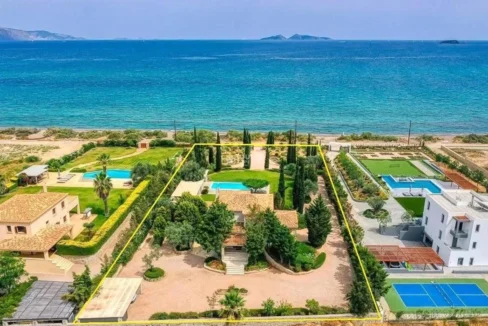
Aerial view of the pine-fringed natural harbour at Porto Heli in the Peloponnese, Greece, with yachts at anchor

The bay that decided everything

Almost everything about Porto Heli follows from the shape of its water. The harbour is a near-enclosed basin, deep right up to the shoreline and sheltered from the meltemi that scours the Cyclades through July and August. Boats that would be pinned down for days on an exposed island mooring lie flat calm here, and have done for as long as anyone has kept records.

That single piece of geography turned a modest fishing settlement into one of the most sought-after addresses on the Greek mainland. Aleppo pine runs down to the water on three sides, the headlands stay low and green, and because almost nothing here was ever built tall, the place still reads as landscape first and resort second. There is no line of concrete along the shore, no cruise terminal, no procession of day-trippers.

Spetses lies fifteen minutes away by water taxi, close enough that the two function as a single social geography: dinner on the island, home the same evening. Hydra is a little further north. The difference, and it is the one that matters to owners, is that from Porto Heli you can also simply get in a car.

Close enough to Athens to actually be used

The drive from Athens International Airport takes a little under three hours, most of it on motorway as far as the Corinth Canal, then an easy coastal road through Epidaurus and Kranidi. High-speed services from Piraeus reach Porto Heli in around two hours. By helicopter it is roughly half an hour.

The practical consequence is worth spelling out, because it is the whole argument for the area. A house here gets used in May and October, not only in August. Owners are not hostage to a ferry timetable, a weather window, or a single seasonal flight route that closes in September. Friends can come for two nights without it becoming an expedition.

It also means the place stays alive out of season. Kranidi, ten minutes inland, is a working town with a hospital, schools, banks and supermarkets that do not shutter in November. That is a rarer quality in Greek second-home markets than buyers expect, and it is the reason a meaningful number of owners here are in residence for far more of the year than they originally planned.

Quiet stone waterfront promenade with tamarisk trees and fishing boats at Porto Heli, Greece

Why buyers choose Porto Heli over the famous islands

The honest answer is discretion. Porto Heli has never traded on being photographed. It has no signature view that appears on a thousand postcards, no caldera, no blue domes. What it has instead is a long-established and largely private summer community, much of it Athenian shipping and business families who have been coming for three generations, joined more recently by European and American buyers who wanted the Aegean without the audience.

The arrival of internationally branded resorts and a deep-water marina over the past fifteen years changed the economics without changing the character. Service standards rose, the airport transfer became routine, and the floor under property values moved up. The planning regime and the topography between them made sure that nothing was built at density.

For a certain buyer this is the entire proposition: Aegean light, a sheltered sea, mainland reliability, and almost no one looking.

Where to buy around Porto Heli, area by area

Porto Heli bay. The core address, and the most liquid. Waterfront and first-line plots command a clear premium, and genuinely new supply is scarce. Properties here tend to resell quickly because the buyer pool already knows the location.

Ververonda. A quieter lagoon just west of the main bay, pine-screened and low density, favoured by owners who want privacy and calm water without leaving the immediate area.

Agios Aimilianos. The peninsula south of the harbour, with the best combination of open sea views and seclusion. Larger plots, contemporary villas, and the strongest growth in values over the last decade.

Koilada. A working fishing and boatbuilding village a short drive north. More authentic, noticeably better value, and increasingly bought by people priced out of the bay itself.

Kranidi. The inland town. Stone houses, real community, year-round services, and prices that have very little to do with the coastal market. A sensible entry point.

Ermioni. A pretty double-harboured town twenty minutes away, with its own loyal following, good tavernas and a gentler price level than Porto Heli proper.

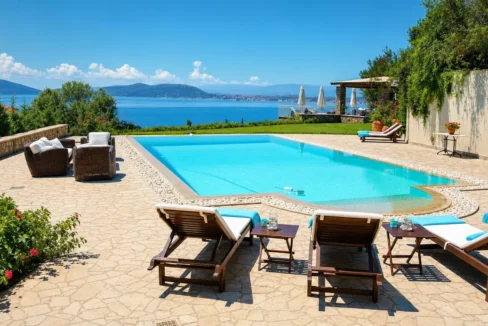
Modern stone and glass villa with an infinity pool overlooking a pine-fringed bay near Porto Heli, Greece

The investment case, stated plainly

Supply is the strongest argument. The buildable coastline around Porto Heli is finite, planning is restrictive, and the pine forest and archaeological designations remove a good deal of what is left. New stock arrives slowly and in small numbers, which is the structural condition under which values hold.

Demand is unusually well balanced. Unlike islands that depend almost entirely on foreign buyers, Porto Heli has a deep domestic market in Athens that does not switch off when international sentiment turns. That has historically made the area less volatile through downturns than the headline island markets.

On price, comparable build quality still trades meaningfully below Mykonos or Santorini per square metre, while rental demand at the top of the market is strong and lengthening at both ends of the season. Greece also operates its residency-by-investment programme on regional thresholds, and the Peloponnese sits in a materially lower band than Attica or the best-known islands. The figures are revised from time to time, so confirm the current threshold with your lawyer before you commit to a budget.

Practical questions buyers ask us about Porto Heli

Is anything open in winter? Yes. The bay is quiet from November, but Kranidi functions normally all year, and a reasonable number of tavernas and shops in Porto Heli stay open. This is not an island that closes.

How do guests arrive? Most drive. Those who prefer not to take the high-speed boat from Piraeus or arrange a transfer from the airport. Both are routine.

Can I let it short-term? Yes, and the top of the villa market lets well through a season that now runs from late May into October. Register the property for short-term letting and declare the income; the rules are enforced.

What about building close to the sea? Expect a setback from the shoreline, forestry designations on much of the pine land, and archaeological checks across the Argolid. None of it is unusual, all of it takes time. Build the timetable into your planning rather than assuming it away.

Is there deep-water berthing? Yes, and it is one of the reasons the area attracts the owners it does.

Buying in Porto Heli

Porto Heli rewards buyers who want the sea on their doorstep without the performance that usually comes with it. It is the rare Greek address that works as a weekend house and a summer house at the same time, and the mainland road is the reason.

The properties below are everything we currently represent in the Porto Heli area. If you would like to see any of them, or want an honest view on which part of the bay suits how you actually intend to use the house, we are glad to talk it through.

The Best Properties for Sale in Porto Heli today

05,November, 2026