


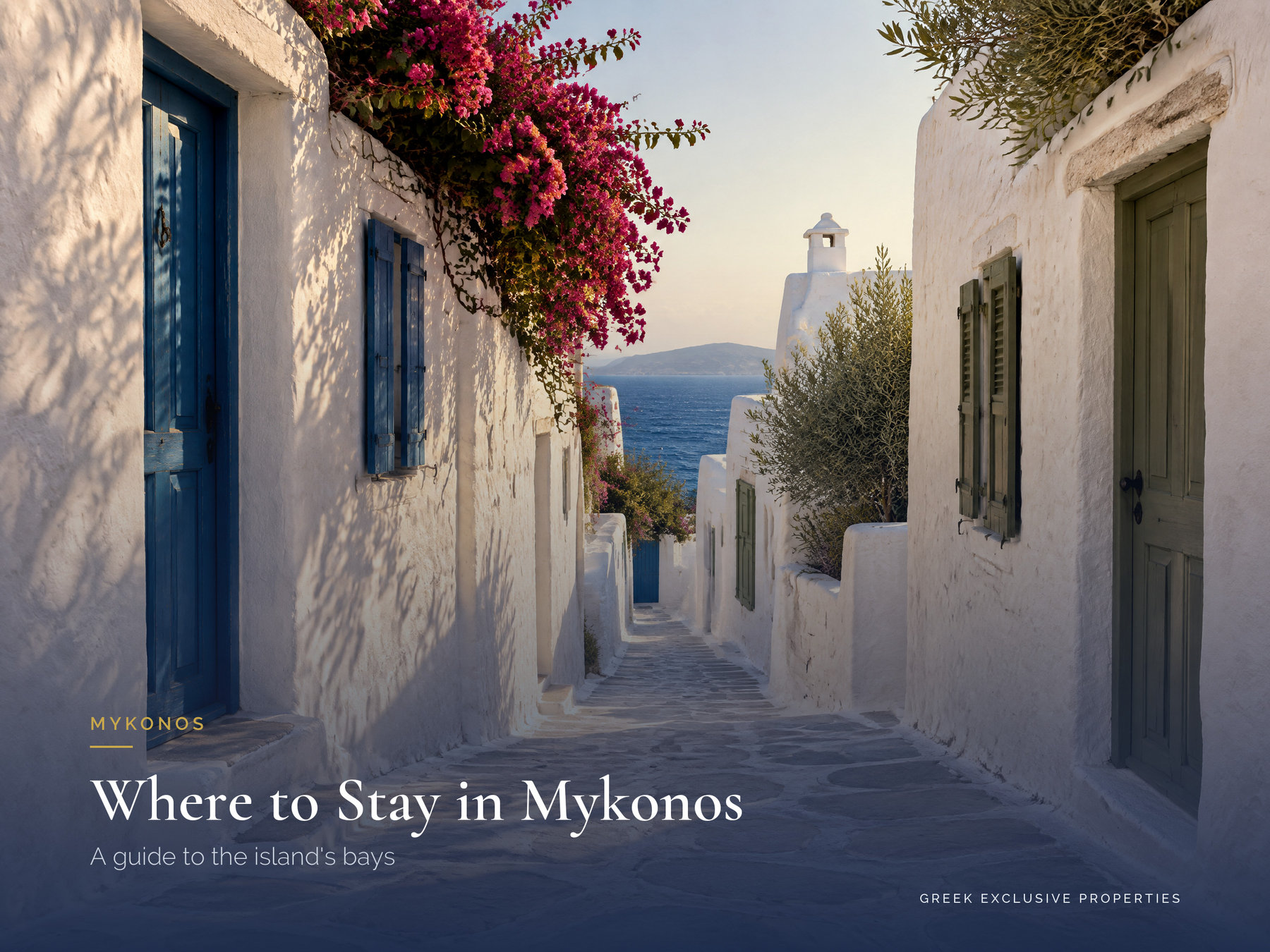
Mykonos • Where to Stay
The island is smaller than its reputation. Twenty minutes separates the loudest bay from the quietest one, and choosing badly is the difference between a holiday you repeat and one you endure.
Most people arrive in Mykonos with one picture in their head: whitewashed lanes, a windmill on a ridge, a beach club at full volume. All of it is real, and all of it sits within a twenty minute drive of places where you will hear nothing but wind and goat bells. The island is barely 85 square kilometres. What changes is not the distance but the character, and it changes sharply from one bay to the next.
We are asked about Mykonos more than any other destination, and the question is almost never about square metres. It is about which side of the island someone should be on. So this is the honest version, area by area, including the ones we would quietly steer you away from if your idea of a good evening is a bottle of wine on a terrace.
Chora, the town itself
Mykonos Town is a genuine Cycladic settlement that happens to have become famous. The lanes were built narrow and confusing on purpose, to break the wind and confuse pirates, and they still do both. Staying inside Chora means you walk everywhere, you eat late, and you do not touch a car for days.
The trade is noise. Matogianni and the streets feeding into it stay loud until very late in July and August, and sound carries between stone walls. If you want the town without the volume, look at the upper lanes climbing towards the windmills, or the quieter edge above the old port. Little Venice is beautiful and completely exposed to both the crowd and the sea spray; it is a place to have a drink, not necessarily to sleep above.
Eating here is the island at its best and its worst in the same street. The rule that has never failed us: walk five minutes further from the waterfront than you intended, and look for a menu that is short.
Ornos and Agios Ioannis, the civilised south-west
Ornos is the most practical base on the island and, for that reason, the one we recommend most often to people who are visiting with a view to buying. It has a sheltered sandy bay, water calm enough for children, tavernas at the sand’s edge, and it is five minutes from town. It is not glamorous. It is extremely comfortable.
Next door, Agios Ioannis faces west across the strait to Delos, which means sunsets that genuinely stop conversation. The hillside is steep, the properties are set into it, and the views are the reason people pay what they pay here.
If you are visiting to look at property
- Base yourself in Ornos or Agios Ioannis. You can reach every part of the island inside half an hour.
- Come in May, June or late September. You will see the island working normally, with the roads and tavernas open but not overwhelmed.
- Drive the north coast at least once before deciding. It is a different island and it changes most people’s shortlist.
- Hire a car, not a quad. The roads are steeper and busier than they look in photographs.
Psarou and Platis Gialos, the expensive south
This is the Mykonos of the magazines. Psarou is a small, deep, perfectly protected bay where the beach clubs are booked weeks ahead and the yachts sit close in. Platis Gialos, around the headland, is larger and more mainstream, and it is the departure point for the boats that run along the southern beaches.
Property here is the most expensive on the island per square metre, and the reason is simple: there is very little of it, the bays cannot be extended, and demand does not soften. If you want this stretch, you are buying scarcity rather than space.
Twenty minutes north, the same money buys three times the land and a view of nothing but sea.
Ano Mera and the interior
Inland Mykonos is farmland. Ano Mera is the island’s second village, built around a sixteenth century monastery, with a real square where people who live here year round eat lunch. There is no sea view from the village itself, which is precisely why the houses around it cost a fraction of the coastal ones.
For anyone thinking about living on the island rather than visiting it, this is the part worth understanding. The interior has water, shelter from the meltemi, and a community that does not evaporate in October.
Panormos, Fokos and the north coast
The north is exposed, wind-scoured and, to our taste, the most beautiful part of Mykonos. Panormos has become fashionable in the last decade; Fokos and the bays east of it have not. The meltemi blows hard here through July and August, which is exactly why the coastline stayed undeveloped long after the south filled up.
Buying in the north means accepting wind. It also means buying the last large plots on the island with genuinely open views, and the ones most likely to still look the same in twenty years.
When to come
July and August are the island at maximum volume and maximum price, and the meltemi can close the ferries for a day at a time. June and September are the obvious answer. May and early October are our own preference: the sea is swimmable, most places are open, and you can park.
Winter is a real season here now, smaller than it was but no longer empty. If you are considering Mykonos as somewhere to actually live, visit in February before you decide anything.
What this means for the market
Mykonos does not behave like the rest of the Cyclades. Supply is genuinely constrained, building rules on the coast are tight, and a large share of the best positions were taken decades ago and rarely return to the market. Prices do not track the national index; they track how many good plots happened to change hands that year.
The practical consequence for a buyer is that the right house in the wrong bay is a worse purchase than a compromise in the right one. Decide where you want to be before you decide what you want to own.
Greek Exclusive Properties
Homes across Mykonos, bay by bay
Our Mykonos portfolio: a curated collection of the finest villas and homes we have for sale across the island, from Ano Mera to the north coast.
Find Properties in Mykonos